


Research
Laboratory Members
Masashi Ishikawa joined Kansai University as an associate professor in 2003. At the outset, the laboratory consisted only of Professor Ishikawa and 12 fourth-year undergraduate students. In the 2026 academic year, it has grown into a group of 29 members: Professor Masashi Ishikawa; one visiting associate professor under the cooperative graduate school program; three visiting researchers; three researchers; two doctoral students; 12 master's students; five fourth-year undergraduate students; and two administrative assistants.
Research Areas
Our laboratory develops high-performance materials for advanced electrochemical energy-storage devices.
Our research focuses primarily on lithium-ion batteries and electrochemical capacitors, while also encompassing hybrid capacitors, magnesium batteries, and related electrochemical energy-storage systems.
Lithium-ion Batteries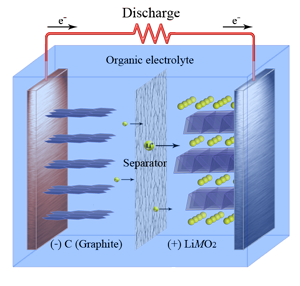
|
Electrochemical Capacitors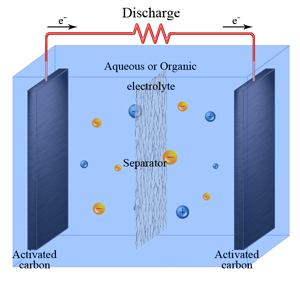 |
|
|
A lithium-ion battery is a rechargeable battery in which lithium ions move between the positive and negative electrodes through the electrolyte during charge and discharge. Compared with many other rechargeable battery chemistries, lithium-ion batteries offer high operating voltage and high energy density. Their combination of high energy density and power capability has enabled compact batteries for mobile phones, laptop computers, and other portable devices. Ongoing improvements in cell capacity and performance have also supported their adoption in hybrid electric vehicles (HEVs) and electric vehicles (EVs). |
Electrochemical capacitors bridge the gap between conventional capacitors and rechargeable batteries. They can charge and discharge at much higher rates and generally offer much longer cycle life than batteries. The systems studied in our laboratory include electric double-layer capacitors (EDLCs) and redox capacitors. EDLCs store charge through the reversible electrostatic adsorption and desorption of electrolyte ions at the electrode/electrolyte interface, without relying on bulk faradaic reactions; this mechanism supports excellent cycle durability. Redox capacitors additionally use reversible redox reactions of electroactive species, increasing charge-storage capacity and potentially improving energy density relative to purely double-layer storage. |
|
We develop electrolyte materials and formulations for high-voltage operation and enhanced safety, together with electrode materials and architectures designed to increase charge-storage capacity and enable rapid charge-discharge. |
Major Lithium-Ion Battery Projects |
Major Research Projects: Capacitors and Emerging Battery Technologies | |
|
|
Collaborative Research
Our laboratory collaborates with industry and other partners on research ranging from fundamental studies to technologies nearing practical implementation. We also provide technical guidance to companies. This academic year, we are conducting 14 collaborative research projects and four contract research projects.