


Facilities and Equipment
Energy Storage Device Development Laboratory (CIC)
▲ Top
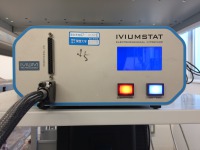
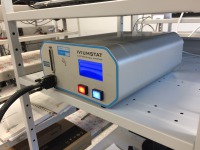
Electrochemical Measurement System (IviumStat.h) |
[HOKUTO DENKO CORPORATION] |
|
|
|
Despite its compact 4 kg design, the system supports high-current measurements up to 10 A and cyclic voltammetry. It can also perform electrochemical measurements such as electrochemical impedance spectroscopy. |
|
|
|
|
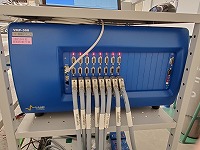
Electrochemical Measurement Systems (Bio Logic ×2) |
[TOYO Corporation] |
|
|
|
These high-performance, multifunctional electrochemical instruments incorporate a potentiostat, galvanostat, and frequency response analyzer (FRA). They support electrochemical techniques including cyclic voltammetry and electrochemical impedance spectroscopy. They can measure low currents, use a high-capacity booster, and perform smooth voltage sweeps comparable to analog waveforms. |
|
|
|
|
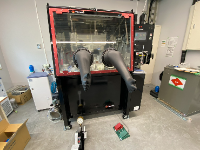
Pure Box (1-person) |
[YAMATO] |
|
|
|
This glovebox is equipped with an automatic gas circulation system. A hydraulic press inside the Pure Box enables pressing operations under an Ar atmosphere. Large and small antechambers enable rapid gas replacement. |
|
|
|
|
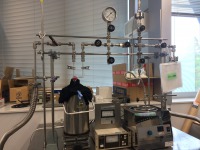
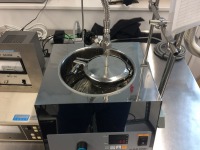
High-Vacuum Line |
[Built in-house] |
|
|
|
This line enables vacuum drying under high vacuum (<0.3 Pa). It is used to remove impurities from ionic liquids and to prepare gel electrolytes. |
|
Nonaqueous Energy Storage Device Development Laboratory (CIC)
▲ Top
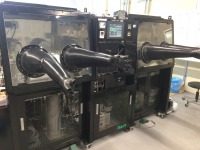
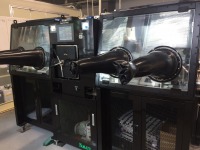
Pure Box (4-person) |
[YAMATO] |
|
|
|
This glovebox has an automatic gas circulation system and consists of 2 connected 2-person gloveboxes. |
|
|
|
|
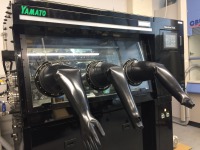
Pure Box (1.5-person) |
[YAMATO] |
|
|
|
This glovebox is equipped with an automatic gas circulation system and provides a larger workspace than the glovebox described above. |
|
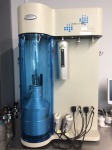
High-Precision Multi-Sample Gas Adsorption Analyzer |
[MITSUWA FRONTECH CORP.] |
|
|
|
The system evaluates specific surface area and pore characteristics from the amount and behavior of inert gas adsorbed on a sample. It can simultaneously measure micropore size distributions for up to 2 samples. |
|
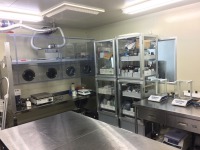
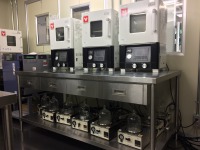
Dry Room |
[Hohsen Corp.] |
|
|
|
This controlled room has a greatly reduced atmospheric moisture level and is used for moisture-sensitive work. It is used primarily for electrode fabrication and electrolyte preparation. |
|
|
|
|
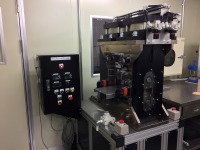
Roll Press |
[Hohsen Corp.] |
|
|
|
This system is used primarily for pressing electrodes. The pressing conditions can be tailored by adjusting the applied load and roll gap. |
|
|
|
|
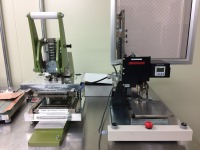
Electrode Preparation System for Aluminum-Laminated Cells |
[Hohsen Corp.] |
|
|
|
This system is used to prepare electrodes for aluminum-laminated cells used in electrochemical measurements. |
|
|
|
|
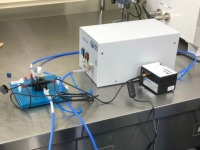
UV-Visible Spectrophotometer |
[OptoSirius Corporation] |
|
|
|
This UV-visible spectrophotometer covers wavelengths from 200 nm to 850 nm. Measurements can be completed rapidly. |
|
Electrical Energy Materials Development Unit Laboratory 1 (HRC)
▲ Top
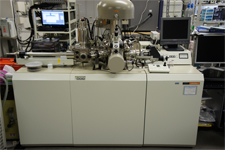
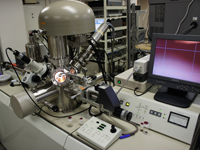
X-ray Photoelectron Spectrometer (XPS) |
[JEOL] |
|
|
|
This system analyzes photoelectrons emitted from a sample under X-ray irradiation. It can determine the elemental composition of a sample surface and |
|
|
|
|
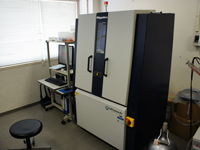
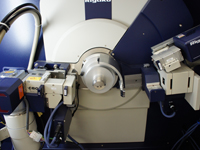
Horizontal-Sample X-ray Diffractometer (XRD) |
[Rigaku] |
|
|
|
This system analyzes sample crystal structures and can measure samples with uneven surfaces as well as thin films. |
|
|
|
|
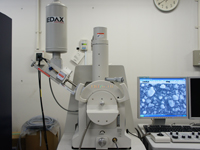
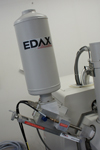
Scanning Electron Microscope and Energy-Dispersive X-ray Spectrometer (SEM-EDX) |
[Hitachi High-Tech, EDAX Japan] |
|
|
|
This system can observe the morphology of submicrometer-scale materials at magnifications of up to approximately 50,000×. |
|
|
|
|
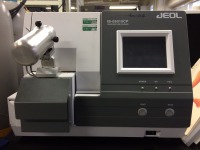
Cross-Section Polisher (CP) |
[JEOL] |
|
|
|
This ion-milling system prepares cross sections of composite materials such as electrodes. |
|
|
|
|
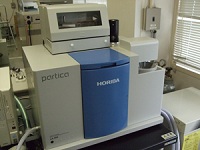
Laser Diffraction/Scattering Particle Size Analyzer |
[HORIBA] |
|
|
|
This system measures particle size distributions from laser diffraction by powder samples. |
|
|
|
|
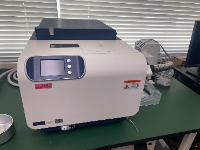
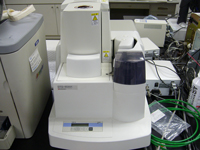
Thermal Analysis Systems (DSC, TG/DTA) |
[Hitachi High-Tech / Shimadzu] |
|
|
|
The differential scanning calorimeter (left: DSC) identifies temperatures at which a sample undergoes phase or state changes. The simultaneous thermogravimetric and differential thermal analyzer (right: TG/DTA) provides detailed information on a sample's thermal decomposition behavior. |
|
|
|
|
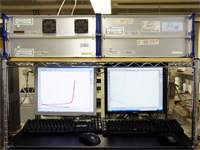
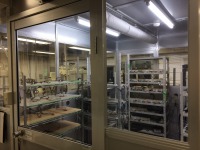
Battery Charge-Discharge Test Systems (BTS ×5) |
[NAGANO] |
|
|
|
Five 30-channel charge-discharge test systems are installed, enabling simultaneous measurements on up to 150 channels. Measurements are conducted in a temperature-controlled room maintained at 25°C. |
|
|
|
|
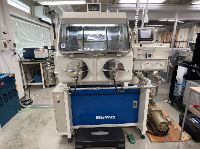
Vacuum Glovebox |
[Miwa Manufacturing Co., Ltd.] |
|
|
|
This glovebox is equipped with an automatic gas circulation system. The main chamber and side chamber can be evacuated, enabling rapid gas replacement. |
|
|
|
|
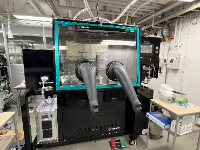
Pure Box (1-person) |
[YAMATO] |
|
|
|
This glovebox is equipped with an automatic gas circulation system. An attached refrigerator enables low-temperature sample storage. Large and small antechambers enable rapid gas replacement. |
|
|
|
|
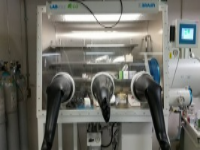
Vacuum Glovebox (1.5-person) |
[BRIGHT CO., LTD.] |
|
|
|
This glovebox is equipped with an automatic gas circulation system. Its large workspace can accommodate many reagents and compact instruments. Large and small antechambers enable rapid gas replacement. |
|
Electrical Energy Materials Development Unit Laboratory 2 (HRC)
▲ Top
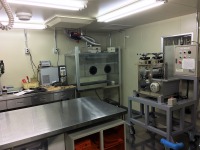
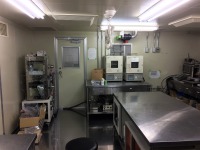
Dry Room |
[ITSWA Co., Ltd.] |
|
|
|
This controlled room has a greatly reduced atmospheric moisture level and is used for moisture-sensitive work. It is used primarily to fabricate laminated cells. |
|
|
|
|
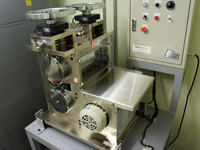
Modular Precision Roll Press |
[Hohsen Corp.] |
|
|
|
This high-precision roll press is used primarily for pressing electrodes. |
|
|
|
|
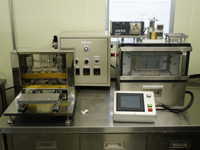
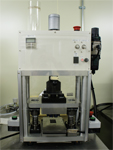
Aluminum-Laminate Forming Machine |
[ITSWA Co., Ltd.] |
|
|
|
This machine is used to fabricate aluminum-laminated cells for electrochemical measurements. |
|
|
|
|
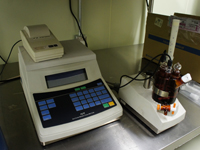
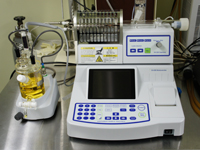
Karl Fischer Moisture Meters ×2 |
[Kyoto Electronics Manufacturing Co., Ltd.,MITSUBISHI CHEMICAL ANALYTECH] |
|
|
|
These instruments measure moisture content down to trace levels of several ppm. |
|
|
|
|
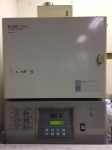
Muffle Furnace |
[ADVANTEC] |
|
|
|
This furnace is used to prepare sulfur/activated-carbon composites. |
|
|
|
|
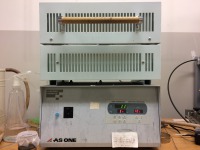
Electric Tube Furnace |
[AS ONE] |
|
|
|
This furnace is used to synthesize active materials and prepare activated carbon. |
|
|
|
|
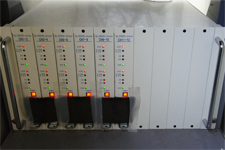
Battery Cycle-Life and Performance Test System |
[Keisokuki Center] |
|
|
|
This battery-specific charge-discharge test system enables high-precision measurements. |
|
|
|
|
Planetary Ball Mills (P7-premiumline, P5) |
[Fritsch Japan] |
|
|
|
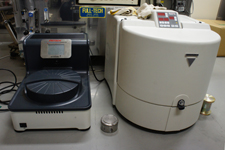
Samples and balls (beads) are placed in a vessel and subjected to high-speed planetary motion for milling. The P7-premiumline unit on the left operates at speeds up to 1100 rpm and can mill samples to the nanoscale within several minutes. The P5 unit on the right can process a larger quantity of sample at one time. |
|
|
|
|
Fourier Transform Infrared Spectrophotometer |
[Bruker Japan K.K.] |
|
|
|
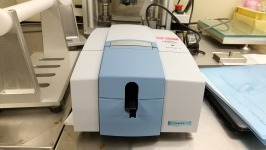
This is a lightweight, compact FTIR spectrophotometer. Interchangeable modules support diffuse reflectance, ATR, and KBr measurement methods. |
|
|
|
|
Centrifuge |
[AS ONE] |
|
|
|
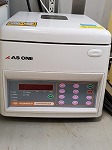
This compact benchtop centrifuge has a maximum speed of 6000 rpm. It accommodates 4 centrifuge tubes. |
|
|
|
Plasma Surface Treatment System |
[TECHNOALPHA] |
|
|
|
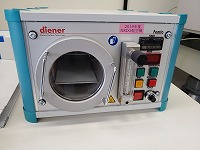
The system can plasma-treat a variety of materials, including electronic substrates, glass substrates, metal substrates, plastics, and powders. It provides a stable plasma with straightforward operation. |
|
|
|
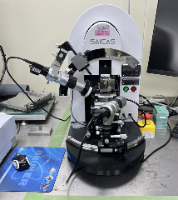
Surface And Interfacial Cutting Analysis System (SAICAS) |
[NIPPON STEEL TECHNOLOGY Co., Ltd.] |
|
|
|
Using a sharp cutting blade, the system makes a low-angle (approximately 0.1°) oblique cut from the sample surface toward the interface with submicrometer precision,
|
|
Electrical Energy Materials Development Unit Laboratory 3 (HRC)
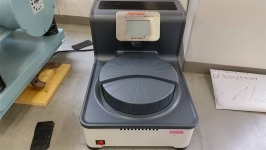
Planetary Ball Mill (P7-premiumline) |
[Fritsch Japan] |
|
|
|
Samples and balls (beads) are placed in a vessel and subjected to high-speed planetary motion for milling. The mill operates at speeds up to 1100 rpm and can mill samples to the nanoscale within several minutes. |
|
|
|
|
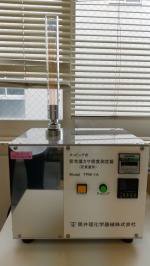
Bulk Density Tester |
[TSUTSUI SCIENTIFIC INSTRUMENTS CO., LTD.] |
|
|
|
This instrument measures tapped bulk density. |
|
|
|
|
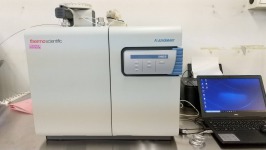
Organic Elemental Analyzer (FlashSmart) |
[Thermo Fisher Scientific] |
|
|
|
Dynamic flash combustion is used to determine the concentrations of carbon, hydrogen, nitrogen, sulfur, and oxygen in samples. The system accommodates a wide variety of samples, including organic and inorganic materials, solids, and liquids. |
|
|
|
|
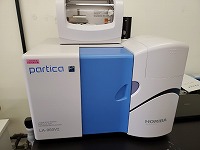
Laser Scattering Particle Size Distribution Analyzer (Partica LA-960V2) |
[HORIBA] |
|
|
|
This particle size distribution analyzer uses laser diffraction/scattering. Its broad measurement range of 10 nm - 5.0 mm enables accurate measurements in the nanoscale region. |
|
|
|
|
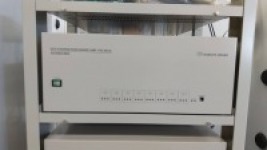
Battery Charge-Discharge Test System (SD8) |
[HOKUTO DENKO CORPORATION] |
|
|
|
The system supports a wide range of measurements, from fundamental battery research and development to cycle-life and evaluation testing. Measurement data can be acquired at intervals as short as 10 msec, capturing rapid changes in voltage and current. |
|
|
|
|
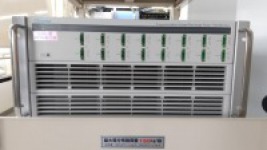
Battery Charge-Discharge Test System (chroma) |
[Hodaka Denshi Co., Ltd.] |
|
|
|
This test system was developed for rechargeable batteries and EDLCs. A single unit supports a variety of high-precision tests. |
|
|
|
|
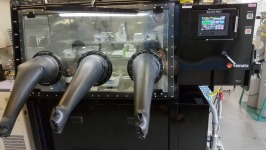
Vacuum Gloveboxes ×2 |
[YAMATO] |
|
|
|
These gloveboxes have automatic gas circulation systems. The main and side chambers can be evacuated, enabling rapid gas replacement. |
|
|
|
|
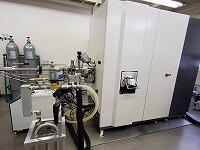
Hard X-ray Photoelectron Spectrometer |
[ULVAC-PHI, Inc.] |
|
|
|
This system analyzes photoelectrons emitted from a sample under hard X-ray irradiation. Compared with conventional systems, it offers greater analysis depth and can non-destructively determine the elemental composition and chemical bonding states below the surface. |
|
Electrical Energy Materials Development Unit Laboratory 4 (HRC)
▲ Top
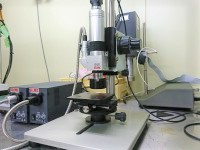
Optical Microscope (SELMIC SEL-270) |
[SELMIC] |
|
|
|
The microscope has a long-working-distance, high-magnification zoom lens covering a magnification range comparable to that of a metallurgical microscope. It offers a large depth of field and is used primarily to observe electrode surfaces. |
|
|
|
|
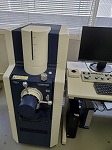
Scanning Electron Microscope and Energy-Dispersive X-ray Spectrometer (Flex-SEM+EDX) |
[Hitachi High-Tech] |
|
|
|
This system can observe the morphology of submicrometer-scale materials at magnifications of up to approximately 50,000×. The energy-dispersive X-ray spectrometer also enables qualitative and quantitative elemental analysis. Scanning transmission electron microscopy (STEM) enables more detailed observation of composition and structure. |
|
|
|
|
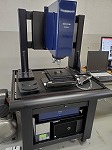
Confocal System for Visualization of Electrochemical Reactions |
[Lasertec] |
|
|
|
This microscope enables in situ observation of lithium-ion batteries. It can monitor active-material expansion, dendrite growth, and related phenomena in real time. |
|
|
|
|
Muffle Furnace |
[ADVANTEC] |
|
|
|
|
This furnace is used to synthesize electrode materials. |
|
|
|
|
Battery Charge-Discharge Test System (chroma) |
[Hodaka Denshi Co., Ltd.] |
|
|
|
|
This test system was developed for rechargeable batteries and EDLCs. A single unit supports a variety of high-precision tests. |
|
|
|
|
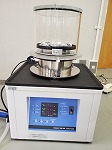
Freeze Dryer |
[AS ONE] |
|
|
|
This system is used to dry active materials and other materials. It can dry materials while preserving their shape. |
|
|
|
|
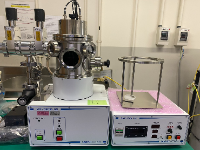
Multi-Target Compact Coater |
[Sanyu Electron Co., Ltd.] |
|
|
|
This system deposits small amounts of metallic species on substrates and electrode surfaces to form thin films. |
|
|
|
|
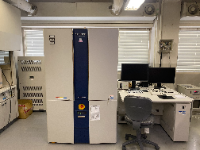
Field-Emission Scanning Electron Microscope (FE-SEM) |
[Hitachi High-Tech] |
|
|
|
The microscope uses secondary electrons and other signals emitted under electron-beam irradiation to observe microscopic features. The energy-dispersive X-ray spectrometer also enables qualitative and quantitative elemental analysis. Scanning transmission electron microscopy (STEM) enables more detailed observation of composition and structure. |
|
Energy Materials Structural Analysis Laboratory (Equipment Purchased through Supplementary Budget)
▲ Top
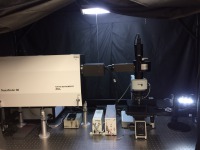
3D Confocal Laser Raman Spectroscopy System |
[Tokyo Instruments] |
|
|
|
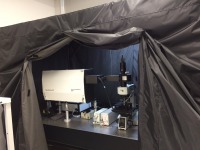
Main applications: Analysis of material surface structures and physical properties The confocal laser Raman microscope can measure solutions, powders, crystals, and gases. In addition to energy-storage materials, it is suitable for structural analysis of electronic materials, liquid crystals, thin films, crystalline materials, glass-based materials, and biological samples. |
|
|
|
|
Next-Generation Scanning Probe Microscope System |
[Shimadzu Corporation] |
|
|
|
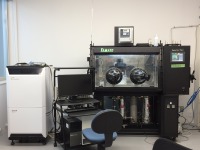
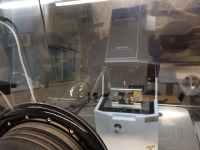
Main applications: Microscale surface topography measurements, including device structures and surfaces of insulating materials Its atomic force microscopy mode enables high-sensitivity, high-resolution measurements of device structures and related samples. Measurements can also be performed inside a glovebox under controlled conditions with moisture and oxygen removed. |
|
|
|
|
High-Resolution 3D X-ray Microscope |
[Rigaku] |
|
|
|
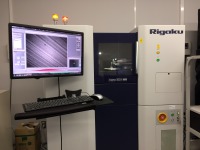
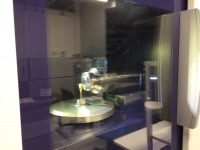
Main applications: Characterization of material microstructures and quantitative measurements non-destructive observation of internal features at the submicrometer scale. The X-ray energy can be selected for the intended application, allowing observation of materials that are difficult to examine with conventional X-ray microscopes. |
|
|
|
|
Glow Discharge Optical Emission Spectrometer |
[Rigaku] |
|
|
|
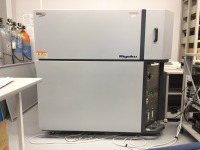
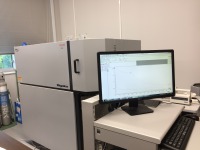
Main applications: Qualitative, quantitative, surface, and depth-profile analysis The system can determine elemental depth distributions in electrodes, identify alloying and impurity elements in metals, and evaluate coating thickness and interfacial elements in plated materials. It can also evaluate film thickness in materials with differing compositions. |
|
Shared Equipment Room 2
▲ Top
Benchtop NMR Spectrometer |
[Oxford Instruments] |
|
|
|
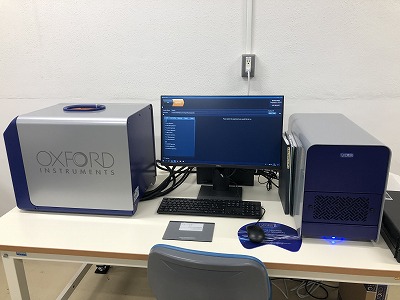
This benchtop NMR spectrometer uses a 60 MHz permanent magnet with high magnetic-field homogeneity and temperature stability. |
|
|
|
|