


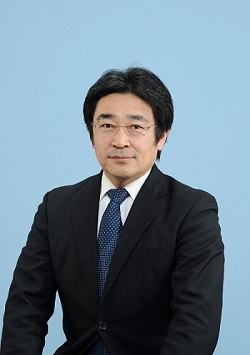
Masashi Ishikawa
Professor, Faculty of Chemistry, Materials and Bioengineering, Kansai University.
He completed the doctoral program at the Graduate School of Engineering, Osaka University, in 1987 and joined the R&D laboratory of Kanebo, Ltd. that year. He became an assistant professor in the Faculty of Engineering at Yamaguchi University in 1991 and an associate professor there in 1997. He joined Kansai University in 2003 and became a professor in 2005.
His fields of expertise are electrochemistry and energy chemistry, with a particular focus on developing rechargeable lithium batteries and high-performance capacitors.


Professor Masashi Ishikawa Receives The Commendation for Science and Technology by the Minister of Education, Culture, Sports, Science and Technology!!
Professor Masashi Ishikawa of the Faculty of Chemistry, Materials and Bioengineering has received The Commendation for Science and Technology by the Minister of Education, Culture, Sports, Science and Technology; Prizes for Science and Technology(Research Category), FY2012 (Heisei 24) for "Research on Enhancing the Performance of Energy Storage Devices through Active Control of Material Interfaces".
Professor Ishikawa has been studying devices that store electrical energy, including rechargeable lithium-ion batteries and electrochemical capacitors. In recent years, he has focused on the material interfaces recognized in this award, aiming to improve the performance of these energy-storage devices. Lithium-ion batteries and similar devices consist primarily of two electrodes and a material called an electrolyte between them. Conventional approaches have focused on improving each material individually. By applying advanced materials such as nanomaterials and ionic liquids, and introducing the novel concept of controlling the interfaces they form, Professor Ishikawa achieved two world-leading performance results.
High-Safety Rechargeable Lithium-Ion Batteries Using Ionic Liquids
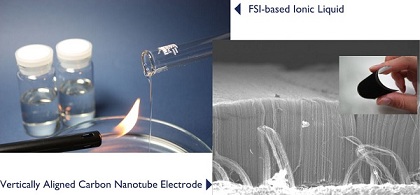
Conventional lithium-ion batteries use flammable organic electrolytes, making it difficult to combine high performance with safety in large-scale applications such as electric vehicles. Ionic liquids are salts composed mainly of organic cations and anions, and exhibit flame-retardant properties despite being organic materials. Their ability to conduct electricity has also attracted attention to their use as electrolytes for next-generation, high-safety lithium-ion batteries. Professor Ishikawa was the first in the world to demonstrate the operation of a lithium-ion battery using only an ionic liquid as the electrolyte. He also discovered that the properties of the interfaces formed by the ionic liquid could enable batteries with higher performance than conventional systems.
The World's Fastest Supercapacitor Using Multi-Walled Carbon Nanotube Electrodes
Like batteries, supercapacitors store electrical energy, but their different charge-storage mechanism allows rapid charging and discharging at high currents. They are therefore used in everyday applications such as large vehicles, trains, electric cranes, and emergency power supplies. While supercapacitors generally use activated carbon, Professor Ishikawa used a new electrode made of well-aligned multi-walled carbon nanotubes to create a distinctive interface on the electrode side. This achieved the world's fastest charge-discharge rate, at least 10 times that of conventional supercapacitors.
These technologies could provide a breakthrough in the widespread adoption of electric vehicles. They could also play an important role in future applications involving renewable energy, such as wind and solar power, and make a substantial contribution to addressing energy challenges in Japan and around the world.